One of the problems with narrative thinking is that it asserts a beginning, a middle and an end, mental constructions that cannot be applied to the complicated fabric of Real Life. But, we don’t all agree on the narrative. One person’s climax is another’s lull.
Beyond Belief: A Review of Helen Pearson’s Book Heralding Evidence
It’s a question that may define our times: What do we really know? Alongside the rise of globally accessible information has been a meteoric rise of mis- and dis-information. There’s a cacophony of talking heads, podcasters, and opinionators ready to fill our heads with digestible soundbites of truthfeel, and authors of all sorts fuelling algorithms with “content”. Experts, too, weigh in and opine. Are they right? Alas, before there’s time to fact-check a thing, the information tsunami has rolled on, leaving us all in a thick sludge of data, half-truths and gut feelings.
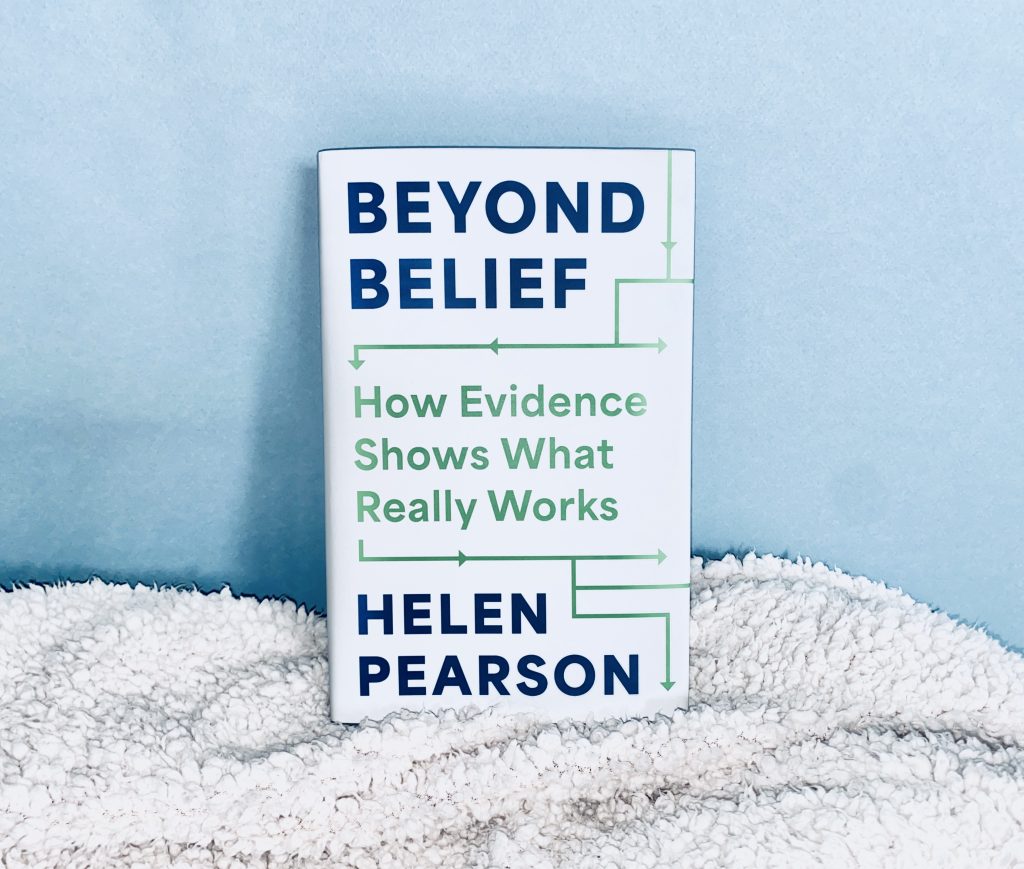
One starting place to answer this question, of course, is to look at the evidence. In her new book Beyond Belief: How Evidence Shows What Really Works (Princeton University Press, April 2026), science journalist Helen Pearson describes the practice of evidence-based decision making across various fields. Now, I say “of course” we can start with the evidence, because that seems like a perfectly logical place to start. Yet, as we learn from Pearson’s book, evidence-based decision making is relatively recent, frequently ignored, and sometimes actively worked against.
Pearson opens her book with a good example: In 1958, Dr. Benjamin Spock, the famous American pediatrician, made a small change to his bestselling parenting book, Baby and Childcare. He recommended placing babies to sleep on their fronts, rather than their backs. This was in a time of debate regarding the cause of SIDS (Sudden Infant Death Syndrome), and it was supposed that babies sleeping on their backs could asphyxiate on their own spit-up. There were various hypotheses, yet, as Pearson writes, “What was missing in all this was evidence from rigorous empirical research.” Eventually, the evidence was in, and as we know by now, it is far safer to put babies on their backs to sleep, but it took until the late ‘80s or early 90s to correct the public record. In the meanwhile, more children died during that period of misunderstanding. Pearson summarizes: “The advocacy of front-sleeping by Spock and others is now understood to have been one of the most lethal pieces of unsubstantiated advice in the history of child health.”
Medicine probably stands foremost in our minds as a field that must surely be evidence-based. Well, increasingly, it is. Though most of us would be surprised to learn that until the early ‘90s, Western medicine was still dominated by “conventional wisdom and questionable opinion.” From one medical school to another, from one doctor to another, from one patient to another, treatments and advice could differ. It tended to follow the most senior physician in the room. How did the senior doctors make their determinations? According to David Sackett, a doctor who was an early advocate of critical appraisal, doctors would generally give one of the following explanations:
- That’s how we’ve always done it.
- That’s how I was taught to do it.
- That’s how this month’s publication of Attending Physician insists we do it.
- That’s how [the textbook] says we should do it.
- That’s how the experts say we should do it.
- Don’t talk back. Just do it.
Pearson’s book describes the emergence and path of evidence-based medicine, as it fought primarily against the establishment of expertise—the tradition of deferring to eminence rather than evidence. Experts were frequently unwilling to yield, taking offense to the idea that evidence might reveal their incorrectness.
Following upon medicine, Pearson devotes chapters to more fields as they take up the mantle of evidence-based decision making: social policy, policing, conservation, business, education and parenting. The underlying question for each involves asking, “What works?” That is, regardless of what the experts say or what we wish were true, what does the evidence show actually works?
Each field presents its own challenges (and advocates) to moving toward evidence-based decision making. There are the hurdles of mindset and money, naturally, though Pearson also describes the wide chasm between research and practical application. Even when the information exists, it has to reach the right persons. In the case of business, for example, a survey of 2500 managers determined that “the majority were still using personal experience or intuition when making decisions. Only 14% had ever read a peer-reviewed scholarly journal.” In education, Pearson writes: “Just supplying schools with evidence is not enough to prompt a change in practice. Hard-working teachers, like conservationists, often lack the necessary capability, opportunity and motivation to act on it.”
Pearson’s book is in many ways a celebration of the advocates who have pushed evidence-based practice forward. She dubs one a “rebel”, describes another as “intent on shaking things up”, fawns over another for “speaking truth to power” or for bringing together an “unusual, rebellious and energetic group of people”. And so on. It’s frankly far too much hero-building, particularly in a book that places a premium on dismantling the deferential mindset that runs counter to following the evidence. The author seems to suffer from the same willful blind-spot as Silicon Valley, which imagines that if you worship rebels that you are not in fact simply building a replacement establishment.
This sycophantic stance is particularly bile-inducing while discussing the field of obstetrics, an area of medicine that was for a long time dominated with great success by female midwives until they were forced out of practice.* The reason for this was the alleged professionalization of the field—though, it’s worth reiterating, the male doctors who forced midwives out were not using evidence-based medicine at this point, it was simply their best guess at the cost of the health of women and babies. Pearson ignores this backstory entirely, leading us to believe childbirth was all quackery until her male hero takes center stage and delivers us enlightenment. Right.
Regardless of that, which we can with a generous mind write off as merely poor storytelling technique, Pearson’s book feels urgent to our time. It is significant and it is important that we use evidence as a force for decision-making rather than someone’s authoritative confidence or the questionable alchemy of experience. And it matters that some people are pushing to make that change in their respective fields. Beyond Belief illustrates to us how rare in fact that can often be. While expertise often has a comorbidity with arrogance, the insistence on following the evidence requires an amount of humility: one must admit on occasion to being wrong and adjust course. When we can harness the strength of expertise together with evidence, lives are saved. Quality of life improves. Education and society can work better for all of us. At least, in the ideal. “The legacy and impacts of imperialism, colonisation and racism are apparent today in the lack of diversity and equity in the evidence movement,” Pearson acknowledges. “There are too few people from low- and middle-income countries, too few women, people of colour and people from other historically under-represented groups—particularly in leadership roles.” When it comes to what questions receive attention and funding, that inclusion matters. It’s difficult to follow the evidence when you haven’t got it.
“Right now, the world needs more people who value evidence,” Pearson writes, “because those who don’t are gaining strength.” While it’s fair to say that contemporary culture has heaped suspicion, contempt, and doubt upon experts, there is a difference between good faith skepticism and bad faith reality-muddying. There are of course flaws in the pursuit of evidence – which Pearson describes throughout her book and I’ll refrain from recapitulating here – but the goal itself serves as a noble North Star. She adopts the pragmatic advice of her subjects: “Aim for better decisions, not perfect ones.”
 Learn more about author Helen Pearson on her website, and buy the book Beyond Belief: How Evidence Shows What Really Works from publisher Princeton University Press (Price: $29.95/£25.00, ISBN: 9780691207070, Published: Apr 28, 2026, Pages: 368, Size: 5.5 x 8.5 in.)
* Note: The history of midwifery various per country and region of course. This refers to the efforts made to delegitimize, restrict, or outlaw midwifery in Western medicine, including the US, UK, Europe and Canada. While modern medicine including evidence-based decision making has resulted in better survival rates for mothers and babies than early healers, it’s important to emphasize that, at the time, those seeking to oust midwives were doing so with patriarchal eminence, not evidence. Women were thereby historically excluded and alienated from the possibility of being frontrunners to the evidence movement in obstetrics.

Related Posts