"Language is meddling even with this very basic perceptual experience. What seems to us so automatic, and so much driven by the world, is instead a combination of factors, including the language that you speak."—Lera Boroditsky, in our interview about her research on language and thought.
Unique and Similar: An Interview with Neuroscientist Rogier Mars
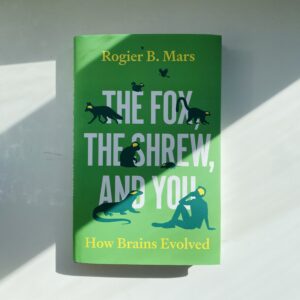
Human history is filled with explanations we’ve articulated to separate ourselves from animals, identifying the myriad ways in which “we” are different—or even better—than “them.” Paramount in those differences has been our brain, the source of our language, culture, complex social dynamics, tool and building capabilities, and more. Yet is our brain really so different?
In his new book The Fox, the Shrew, and You (Princeton University Press, 2026), neuroscientist Rogier B. Mars walks us down the long evolutionary tract of the development of the brain. Mars brings in the latest scientific knowledge of brains across the animal kingdom to illustrate the differences, as well as the many similarities, among us. In this interview, we speak about the brain as a foraging device, popular brain myths and the harm they can do, and the complex problems that helped to shape our species.
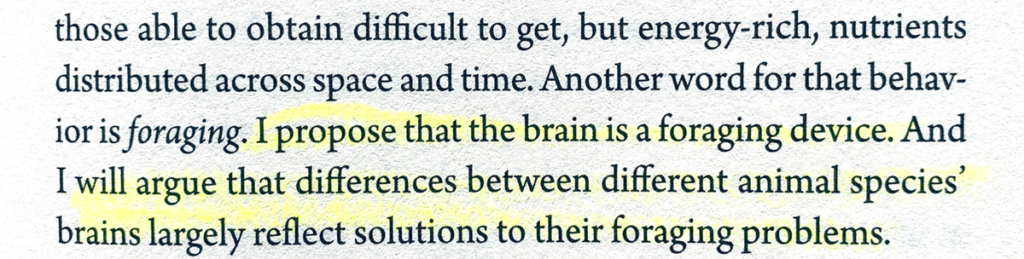
Your book views the brain through the lens that its purpose is to forage—it’s an instrument to obtain “energy-rich, nutrients distributed across space and time.” This is a particularly interesting position because it stands in contrast with the popular argument asserting its primary function is to seek sex and reproduction. How or why do you arrive to this lens?
Well, sex doesn’t seem to require much of a brain. Even animals with the smallest brains are able to do it. That doesn’t mean that our brain doesn’t have a role in our social interactions in partner choice, etcetera, but I think that because we solved certain problems in our environment, that made our life very complex and, as part of that, our social life became very complex. I don’t think our brain evolved to solve the problem of partner selection, because that really wasn’t an issue until we became a pair-bonding, complex group-living collective, problem-solving species.
In the old literature on brain size study across species, there’s a bit of a divide between the foraging people and the social people. So, this is the Social Brain Hypothesis, that brain size increased to keep up with the demand for living in large social groups, and actually, you can see the social quality as a way of problem-solving—there’s good evidence for that. Our hunter-gathering ancestors teamed up with one another, divided the labor in certain ways, and that was their way of surviving. That meant we needed many skills: to be able to deal with freeloaders, to be able to rely on one another, to have binding agreements over time, and so forth. So, our social life became indeed very complicated, but in order to solve that original problem of foraging.
You describe in the book the problem of being a mammal, which puts us in a constant race against time. Reptiles, who don’t need to generate their own heat, can be sated with less frequent or constant meals, but as mammals we’re constantly working against a setting sun. How has that contributed to the formation of our brain and our way of being in the world?
We, as warm-blooded animals, need food on a regular basis. In the book, I describe an experiment done by a colleague of mine: Imagine you’re a little bird and you have to make a decision on what food to go for. That decision-making weighs what you know about risk and possible reward. In the early morning, you will go for the safe options, but later on in the day, when you know you have to reach enough calories or you won’t survive the night, the calculation changes. Your choices change based on that updated calculation of risk and reward.
A lot of our decision-making strategies, even for complex decision-making, come from that kind of thinking. We test a lot in the laboratory on children or for certain patient groups, how good they are they at that kind of cost-benefit analysis. That’s a complicated process that our brain is tailored for.
How does this decision-making thinking apply in a more abstract way? For example, if our brains our resource-driven, why would you invest your much-needed energy on writing this book?
We have solved our problems by building a very complex society where we have to teach our young over a very long time. We’re able to pass on knowledge across generations. Now, of course, I’m not saying I sat down and said to myself, “Oh, I need to pass my knowledge on through generations!” but that is how we built our society. Having the written word and being able to pass on knowledge is one of the things that has made humans so incredibly dominant, I would argue. We can read words written two thousand years ago. It fits in with how we’ve built our society as a way we solve our problems.
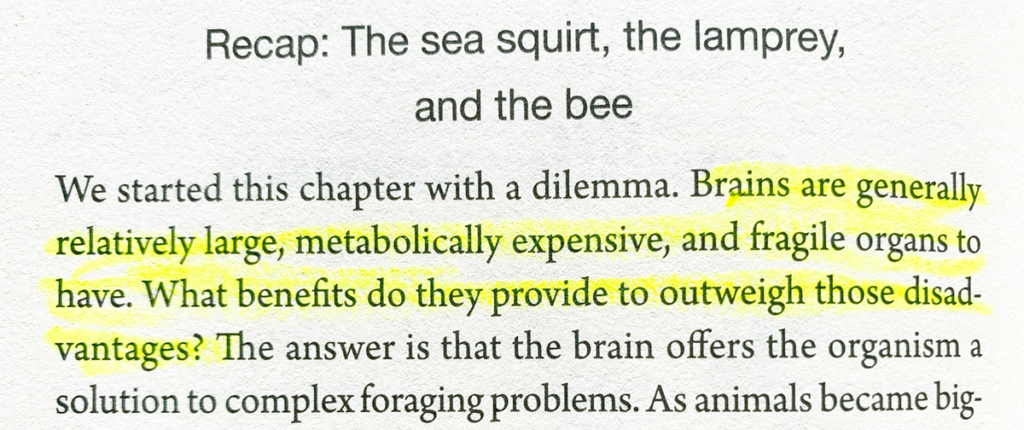
Your book is organized around the idea of laying out, chapter by chapter, a description of contrasting brain capabilities between animals, and there’s of course a throughline of how that relates to human brains. I keep catching myself around my wording here, because it’s very tempting to describe our own capabilities as “more advanced”…
It’s so easy to slip into that, isn’t it? I mean, ultimately, what would be more exciting than to write a book from the perspective of a completely different animal, who would obviously argue that they are the advanced one. So, yes, I’ve taken the steps that lead to us to that way of thinking, but that doesn’t mean that we are the natural end point. In a way, we’re all equally evolved, right?
Are there any brain capabilities of another animal that make you particularly jealous?
One thing that amazes me that I don’t think we can at all understand is the idea that a bird’s brain is just like ours in a way—the convergence between the two of us is that we can pack a lot of neurons in a very tight space. A scrub jay’s brain is less than 10 grams, yet they can really plan for the future by storing the right kind of food even though they’re not hungry at the moment. They know when there are other scrub jays looking at them who might steal their food, so when that other scrub jay is not looking, they recache their food. All that complex behavior in such a tiny brain really fascinated me.
I’m also quite intrigued at the moment by some of the mammals that went back to the water, carnivores like walruses and seals. Some of these animals can communicate over extremely long distances in the water. That is quite cool.
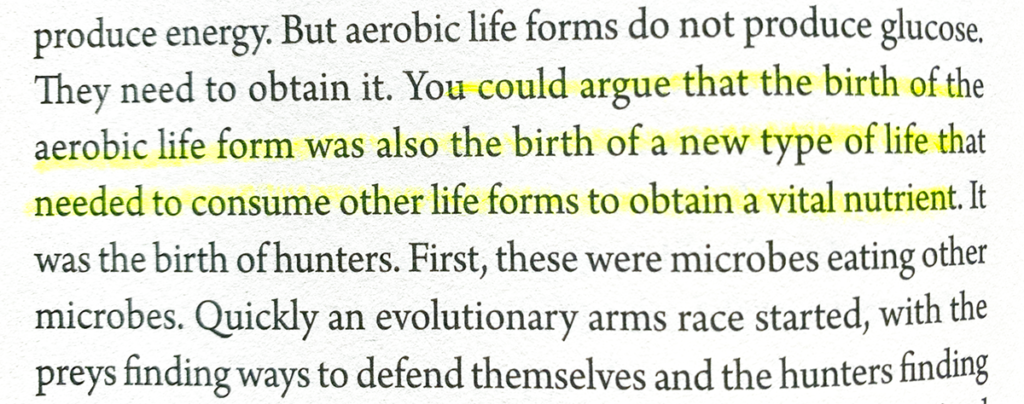
I’m hearing now your emphasis on carnivores. In the book, you highlight that transition when some life-forms begin to eat other life-forms as a pivotal change. Why is that?
Because that’s where the foraging problem became more complex. We are no longer just floating around in the water and anything that floats into our mouth is good. Now, there’s some food that was trying to get away from us, which was more complexly distributed. It meant that we might have to forage while also we have to be afraid not to be eaten. That’s a pivotal moment where the problem becomes more complex.
You mentioned the density of neurons in the bird’s brain. in the book you explain how more neurons per unit of space in the brain contributes to processing power, but then clarify that “computational power in itself doesn’t say much about what the brain is specialized for.” Can you elaborate for us why the number of neurons matters and why it doesn’t?
The neuron is the processing unit, right? So, more processing units should make you better at something. It’s important to count the number of processing units rather than just look at the size of the brain because, for example, an elephant brain is big but very inefficient at packing its neurons—probably because it just didn’t have to care about that because the animal is big enough anyway. That’s the reason why it does matter. However, the number of neurons is not the whole story. How you connect those processing units up differs a lot, and I think that’s where the interesting information really is.
Let’s say you’ve got a brain of a certain size. In our primate brain, a lot of it is devoted to processing visual information, whereas in most mammals, a lot of it is devoted to smell and maybe sound. That tells you more about what the brain is really doing or what it’s for. And it’s only recently that we have the tools to look at that organization in a lot of species at the same time, so that’s what made the time ripe for me to write this book: we can now start piecing that together instead of just having endless debates about what it means to have a bigger brain.
You also mention in your book that previous estimates of neurons in the human brain were basically guesstimates, but the neuroscientist Suzana Herculano-Houzel developed a method to actually count the number of neurons. So there’s another way the science has advanced the conversation.
Yes, she starts one of her papers by saying, there’s been this idea that we had 100 billion neurons, right? But nobody had counted it. And then she counted it. The number is 86 billion. I saw online that somebody commented about my book, “Okay, I need to read this… but if he says that we’ve got 86 billion neurons, I’m throwing it away.” But that’s the actual number! That’s one myth that turned out to be true.
One thing I loved about your book is that you bring up some of the many myths, misperceptions and obsolete ideas in brain science, to essentially describe how we now know them not to be true, such as the idea that the mammalian brain is basically a reptile brain with a neocortex slapped on top, or that it can be divided into the lizard brain, emotional brain, and rational brain. Can you tell us about how we now know that to be false, and why it matters?
We understand a lot better now how we can look at different parts of the brain. And importantly, we can look now at enough species in enough detail that we can sort of reconstruct the source of things. I always ask my audiences in the field of neuroscience: If you’re interested in the brain and mind and behavior relationship, why just study one species when evolution gave you this natural experiment to look at? That context is incredibly important to understand our brain and ourselves and how to help people who have a problem. Because, look, our brain is not an optimal solution. It is not something you would design that way. It is a very strange “plug and play.” From that perspective, it’s incredibly important to see where it is coming from because otherwise we simply can’t understand it.
In your book, you write about convergent evolution, which is “where a similar feature has evolved multiple times in unrelated species.” So, things that we might’ve assumed previously as belonging to a common ancestor turn out to have branched much sooner, but both species ended up with roughly the same solution to a problem. What does that tell us about why something has developed?
Certain solutions coming up multiple times probably means that something that is quite useful and quite likely to happen. Going back that far on the evolutionary branch to see where things diverged really helps us understand a lot of things that we sort of take for granted.
I’ll give you an example. When I was reading the papers for the book, one of the things that excited me most, which is probably a very nerdy thing, but there’s an experiment where they look at how the mouse processes a visual scene, and it turns out that they do it completely differently than we do. We humans use the information from our two eyes to look, and each eye can see slightly different views of an object, which is how we can distinguish it from the background. Our brain is a completely visual brain and that fact works its way through everything, right? We use visual metaphors when we talk, we think in a spatio-visual format. The mouse does visual processing in a very different way, and realizing this difference in a species that we study a lot—the rodent—makes me think that there are so many assumptions in how our brain works, how our mind works, and how everybody’s minds work. Assumptions which are probably not correct.
It’s a very important check on our understanding, both as a neuroscientist, but also just as a human.
Some of those early misperceptions or assumptions about how brains work became metaphors that have been widely adopted, for example, describing some human thinking or behavior as taking place in the “reptilian brain”. Can those metaphors still be helpful to us, or does that thinking just take us down the wrong path?
I think they can be helpful but also sometimes they put us on a path that I don’t really like. One example that comes to mind is this distinction between the “emotional” and the “rational” brain, but the brain doesn’t really support that distinction. There’s this work by Daniel Kahneman who made the distinction between thinking fast and slow, and that’s probably a better metaphor. That metaphor also uses two ways of processing information and helping you reach your decisions, but if you position it as an “emotional” versus “rational” brain, it’s got value judgment, right? One is better than the other. So, I do feel like those metaphors can sometimes be dangerous because there’s a value attached to them.
You write in the book that “the brain handily hijacks existing structures and abilities for novel uses,” which is a fascinating adaptation. Can you elaborate on that? Does that relate to brain plasticity?
Plasticity is more about the change that happens over your lifetime. So, if I lose some fingers, the representation of that in my brain will be taken over by other parts of the hand. What I mean by hijacking is that a part of the brain originally meant for one purpose can be used for other purposes. For example, a lot of our systems are visual because that is the basis of our brain. I mention in the book a “stretchy bird” study. The idea is, we’ve got this old structure, the hippocampus, which is used for navigation and systems feeding into that, and it turns out we use that same system when navigating abstract spaces. In this study, they showed pictures of birds and they could either stretch the neck or the legs of the bird and then you as the participant would travel through an environment based accordingly to that bird type. Your hippocampus uses the same kind of properties to navigate that kind of weird abstract space as it would do physical space. I quite like the study (partly because it was my wife who did it) but then another colleague furthered that into a study that asked, is that how you structure your social domain as well? He showed people faces so that you essentially learned the relationship between pairs of faces. Obviously there was a much more abstract social network around it, but you never saw that. The participants had to build that up just by knowing the pair relationships. And that study showed that you use exactly the same system. The hippocampus is such an evolutionarily old structure, but it’s acting in novel ways on these complex stimuli, which is quite fascinating.
Does that suggest that this is really basic behavior baked into all brains, rather than something specific to humans?
It’s more nuanced than that. It’s like we’ve all got this basic machinery, but we humans feed it a lot of different information and it gives us something different. That’s another example where we can see that our brain is not just an animal brain with something else on top of it. It’s the whole processing pipeline. Every bit can be modified. Twenty or thirty years ago, we assumed it was all about the prefrontal cortex. That’s what makes us human, right? The top of the brain, that must be it. And yes, it’s involved in lots of complex behaviors, but actually, when we look now and compare our brain to that of the chimp or the macaque monkey, it’s some of the input of the prefrontal cortex that’s really modified. So we’ve not stuck something on top of that, we’ve made the information going in much more complex.
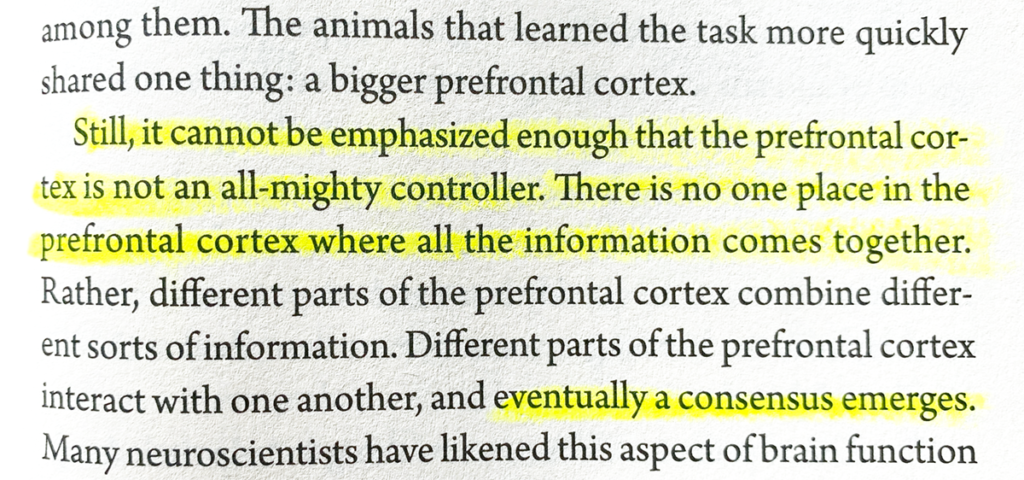
You write in the book that the role of the prefrontal cortex is rather overstated, in the sense that it is not an executive that brings everything together—a function that just doesn’t exist. This is an idea that’s really easy to get stuck on, since we all experience an “I” and some of us hear a voice in our minds that we can identify as “ourselves.” Can you speak to what this looks like from the brain science perspective?
That is to a large degree one of our remaining mysteries because, more and more, what we see is things are indeed more separated than we think—to an astonishing extent. For example, there’s a study that I describe in the book, which shows that frogs process the most basic visual information —namely: Am I jumping away from a predator? Or am I jumping to avoid an obstacle? — by different visual streams. Those two questions are addressed in different parts of the brain. I’m sure the frog doesn’t experience it in that way. So, why does it seem so integrated to us? That remains to be seen.
We’re making more progress on understanding how can we make all these decisions without a controller. For instance, there’s this nice data now about just a very simple task: If I see a light and I need to press a left or right button, traditionally we thought there needs to be some unit that in the end makes the decision that you’re doing either X or Y, and that turns out not to be true. You’ve just got two competing streams of information that are mutually trying to stop the other and in the end one will win. So you can see that simple process without a central director, and some version of that must be happening also in much more complex processes. It remains to be seen how.
I do need to slightly correct myself, though, because in the human brain what we do see is that some of those streams do tend to interact a little bit more than you see in even our closest relatives. Our brain is capable of wiring up some of those separate streams. That is an interesting data point.
You name one of the main reasons that we’re able to know more about brains now is MRI machines. What is the next obstruction currently blocking further learning?
My optimistic view would be that we actually have taken away quite a lot of the hindrances and now we need to start putting it all together. So, what I do is collect a lot of data and make maps of all these different brains, which is anatomy, but ultimately that needs to be linked to behavior. That’s a whole different specialization. The intermediate level, linking together anatomy to behavior, is where we now need to make progress. It is starting now, but it’s really breaking down silos within the fields.
What do you wish that more people knew about the brain?
I want people to realize how complex it is, and move away from the very simple metaphors. It’s fascinating to me that there is still so much to discover. I think we’re doing well but I quite like that it is okay to acknowledge that we are very complex. It’s a complex story of a long history, and that’s what makes it cool.
What about the human brain, in particular?
Our type of primate is very good at getting a quick overview of the situation. I think that may even be the basis of a lot of the things that we think make us so special. For example, analogical reasoning, like snow is to snowflake as soldier is to army—that kind of thing. We are very good at this and we do it a lot. We categorize. The people with exceptional memory use categorization, and good strategies of categorization, to do it. But it’s also something that we do in our social world. We immediately categorize people. That quick categorizing is so essential to our daily life, maybe without realizing it. That for me was the standout insight that made me realize what this could tell us about ourselves.
 The Fox, the Shrew and You is available from Princeton University Press.

Related Posts